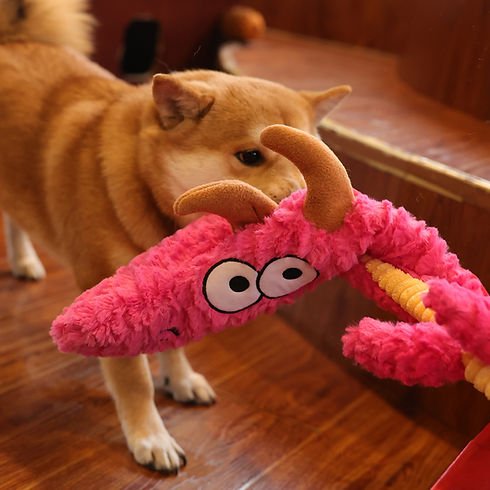
In a world that often celebrates boisterous energy, the quiet souls can be overlooked. This was the story of our Daniel, a four-year-old, golden-hued Shiba Inu. His demeanor is one of serene observation. While other dogs might bark with excitement at the doorbell, Daniel would simply lift his head, assess the situation with a thoughtful gaze, and often return to his rest. He was, and is, a gentleman of few words and independent spirit. For years, this beautiful temperament posed a unique challenge: how do you play with a dog who seems disinterested in the chaotic frenzy of a standard game of fetch and is too dignified to tear apart a squeaky toy?
Our early attempts to engage him were met with polite indifference. A ball rolled his way would be glanced at and ignored. A crinkly plush fox might earn a perfunctory sniff before he’d walk away, leaving us with a pile of brightly colored, rejected amusements. It wasn’t that he was unhappy; he was unfulfilled. We could see a latent intelligence in his eyes, a desire for a challenge that respected his thoughtful nature. The problem wasn’t Daniel; it was that the toys we offered were beneath his cognitive abilities. They required no thought, only instinct, and Daniel’s world was one of quiet contemplation.
The breakthrough came not from a louder toy, but from a quieter one. It was the day we introduced the first prototype of what would become our “Maze Bowl.” This wasn’t a toy to be chased; it was a puzzle to be solved. We placed his evening kibble inside the gentle, winding grooves and placed it before him. He approached with his typical caution. He sniffed the perimeter. Then, something clicked. He lowered his head and used his delicate, fox-like nose to push a single piece of kibble along the track. It was a slow, methodical process. There was no frantic gobbling. This was a deliberate, focused effort.
Watching Daniel with the Maze Bowl was like watching a scholar solve a complex equation. His entire being was concentrated on the task. His tail gave a soft, thoughtful wag, not of frantic excitement, but of deep satisfaction. For the first time, a “toy” was speaking his language. It was asking a question of his mind, not just his body, and he was brilliantly providing the answer. This was the key we had been searching for: engagement over exertion.
Building on this success, we began designing toys specifically for the “thinkers” like Daniel. The “Puzzle Cube – Gentle” was our next triumph. With larger, smoother sliding panels and flip lids that required a precise nudge rather than a forceful paw, it was perfectly suited to his style. He would spend upwards of twenty minutes working through the sequence to access the hidden, high-value treats. The victory wasn’t in the consumption of the treat, but in the silent, proud look he would give us after hearing the final “click” of a compartment opening. He had accomplished something.
The impact on Daniel’s overall well-being was profound and subtle. The dog who once spent his days napping and watching the world go by now had a purpose. He would often, of his own volition, go to the cupboard where his puzzle toys were kept and sit patiently, waiting for his daily mental workout. The mental fatigue from a 20-minute session with the Puzzle Cube was more exhausting for him than a mile-long walk. He would finish, drink deeply from his water bowl, and settle into a rest that was truly earned—a rest of the mind.
Daniel taught us one of the most valuable lessons at QT Pets: play is not a one-size-fits-all activity. For some dogs, joy is a loud, communal event. For others, like our Daniel, joy is a quiet, personal triumph. It is the profound satisfaction of a challenge met and a problem solved. He no longer wanders past his toy box in disinterest; he is an active participant in his own enrichment, a quiet soul who has finally found his voice in the language of thoughtful play.
Our toys for dogs like Daniel aren’t designed to change who they are. They are designed to celebrate who they are. They provide a sanctuary for their minds, a respectful challenge that honors their intelligence and independence. In giving Daniel the right tools, we didn’t just find a way to play with him; we found a way to understand him, and in doing so, we unlocked a world of quiet, profound joy for our beloved, thoughtful boy.